
Polished concrete has become one of the most popular flooring choices for homes and commercial spaces across Adelaide. It’s sleek, durable, and incredibly low-maintenance. But what actually happens during the polishing process? Understanding the steps involved helps explain why professional concrete polishing delivers results that last for decades.
Vision Grind and Polish specialises in concrete polishing across Adelaide, transforming rough or dull concrete into smooth, attractive surfaces. Here’s a clear breakdown of how a polished concrete floor is created.
1
Initial Surface Assessment and Preparation
Before grinding begins, the concrete is thoroughly assessed to determine the best approach for your floor.
Professionals inspect the slab for cracks, surface inconsistencies, old coatings, adhesives, and contaminants. Any damage is repaired so the surface can be polished evenly. Coatings, glue, paint, and residue must be removed early so densifiers and sealers can perform properly later.
Many of Adelaide’s older homes feature concrete with mixed hardness levels due to age, different pour batches, or long-term weather exposure. Identifying these variations helps determine the correct tooling and grinding pressure.
The slab must also be dry, as excess moisture can interfere with densifier penetration or sealer performance.
2
Concrete Grinding and Levelling
Grinding is the foundation of the polished concrete process. This removes the top layer of concrete, exposes a fresh surface, and levels the slab.
Coarse Grinding (30-40 Grit)
The first pass uses coarse diamond tooling to remove imperfections, old coatings, and uneven sections. This cut exposes clean concrete ready for refinement.
Medium Grinding (80-120 Grit)
Medium-grit diamonds remove scratches from the coarse cut and further refine the surface.
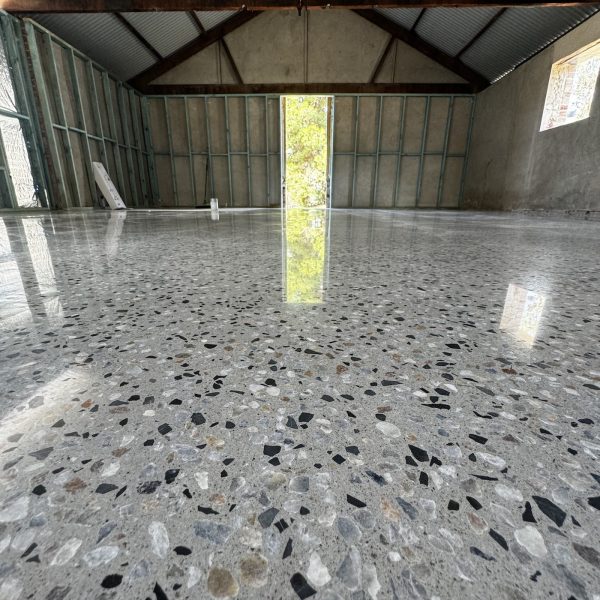
The level of aggregate exposure – light, medium, or full – depends on how much material is removed and the look you prefer.
3
Crack and Joint Repair
Once the initial grinding reveals any hidden cracks, repairs are carried out.
Small cracks are filled with epoxy or polyurethane fillers designed for concrete. Larger cracks may require specialist treatment depending on movement or cause.
Control joints may be filled for a seamless look or left exposed for a traditional appearance.
Because parts of Adelaide sit on clay soils that can cause slab movement over time, stabilising cracks during the polishing process helps improve long-term appearance and keeps the surface dust-free.
4
Densifier Application
A densifier—a liquid chemical hardener—is applied to strengthen the concrete. It penetrates the slab and reacts with the concrete’s free lime, forming additional calcium silicate hydrate (C-S-H). This fills the pores within the slab, making the concrete harder, more durable, and more resistant to dusting.
Depending on the concrete’s age and porosity, one or more coats may be used.
5
Progressive Polishing Stages
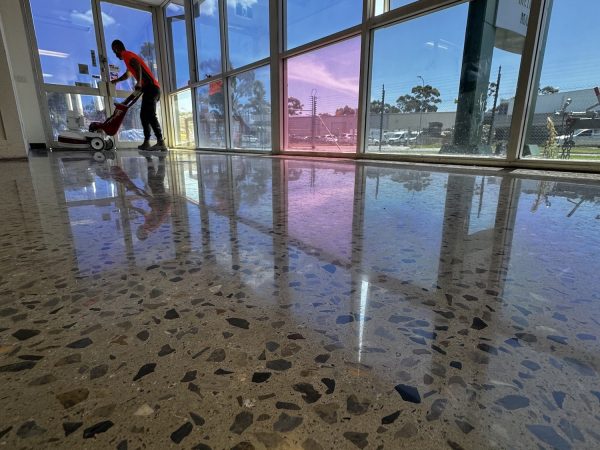
After densification and drying, polishing begins. This involves using progressively finer diamond pads to refine the concrete to the desired level of shine.
6
Progressive Polishing Stages
After densification and drying, polishing begins. This involves using progressively finer diamond pads to refine the concrete to the desired level of shine.
Fine Grinding (200-400 Grit)
These stages remove remaining scratches and start producing a soft sheen.
Polishing (800-1500 Grit)
Higher-grit pads refine the surface to create a clear, reflective finish.
Most Adelaide homeowners choose between 800 and 1500 grit for a balance of shine and slip resistance.
Final Polishing (3000+ Grit)
The highest grits produce a true high-gloss, mirror-like finish.
The chosen final grit determines whether your floor has a satin, semi-gloss, or high-gloss look.
7
Sealer Application
The final step is sealing and protecting the floor.
Mechanically polished concrete doesn’t rely on a thick topical coating—the densifier has already hardened the slab internally. However, a sealer is often applied to enhance stain resistance and add extra protection.
Common options include:
- Penetrating sealers – soak into the slab without changing appearance
- Topical sealers – sit on the surface and boost gloss
- Hybrid systems – combine penetration and surface protection
For most Adelaide homes, penetrating sealers work best as they maintain the natural look of polished concrete while resisting spills and stains.
How Long Does the Polishing Process Take?
Timeframes vary depending on:
- Floor size
- Existing damage or coatings
- Desired gloss level
- Access and site conditions
A residential garage may take 1–2 days, while larger commercial sites can take a week or more. Each stage must be completed properly for long-lasting results.
Vision Grind and Polish provides accurate timelines during quoting based on your floor’s condition and your chosen finish.
What Makes Professional Polishing Different
The concrete polishing process requires specialised equipment and expertise that DIY approaches can’t match.
Professional-Grade Equipment
Industrial concrete grinders weigh hundreds of kilograms and use diamond tooling that costs thousands of dollars. These machines provide consistent pressure and speed across the entire floor surface.
Rental machines available to homeowners lack the power and precision needed for quality results. They often leave swirl marks, uneven finishes, or fail to adequately level the surface.
Technical Knowledge
Knowing which grit sequence to use, how long to apply densifiers, and how to address problem areas comes from experience. Professionals can adjust their approach based on the concrete’s hardness, age, and condition.
Adelaide’s concrete varies significantly depending on when and how it was poured. Properties built in different eras used different mix designs and aggregate types. Recognising these differences and adapting the polishing process accordingly produces better outcomes.
Proper Dust Control
Concrete grinding generates enormous amounts of fine silica dust. Professional equipment includes integrated dust extraction systems that capture nearly all airborne particles.
Without proper dust control, the particles settle throughout your property, creating extensive cleanup problems. More importantly, silica dust poses serious health risks when inhaled.
Maintaining Your Polished Concrete
Polished concrete is extremely low-maintenance:
- Dust mop or vacuum regularly
- Damp mop with pH-neutral cleaner
- Avoid harsh or acidic chemicals
- High-traffic areas can be quickly re-polished to restore shine
This simple maintenance keeps your floor looking its best for years.
Why Choose Professional Concrete Polishing in Adelaide
Polished concrete delivers a permanent, low-maintenance, hypoallergenic flooring solution that won’t peel or wear like coatings. It stays cool in summer, pairs perfectly with underfloor heating, and suits both modern and traditional Adelaide homes.
Vision Grind and Polish brings the experience, equipment, and attention to detail needed to transform dull concrete into a smooth, durable, and visually striking surface – whether for a garage, warehouse, retail space, or modern home interior. Contact our professional team for a free quote.