
Retail stores, warehouses, and industrial facilities put a floor under more strain than a typical home ever will. Forklift traffic in warehouses creates constant impact and abrasion. Retail environments deal with spills, scuffs, and thousands of footsteps daily. Manufacturing facilities need chemical resistance and easy cleaning protocols on top of that.
Traditional flooring options often struggle under these conditions. Tiles crack, and grout lines trap dirt in high-traffic areas. Painted floors peel and chip within months under constant wear. Epoxy’s seamless, chemically bonded surface avoids both problems, and penetrates into the concrete substrate to create a single floor system that distributes loads evenly rather than cracking at joints or seams.
Polished concrete is a common alternative worth weighing up too. If you’re deciding between the two for a commercial space, we’ve compared epoxy vs polished concrete for commercial spaces in more detail separately.
If you’re weighing up whether commercial epoxy flooring is right for your space, it helps to understand what the installation actually involves, and how it’s built to handle that level of use.
The coating system: more than one layer
Commercial epoxy flooring isn’t a single coat. It’s built in layers, and each one does a different job.
A primer coat goes down first. Its role is adhesion, giving the layers above something to properly bond to. On top of that, one or more base coats build thickness and strength. This is what gives the floor its load-bearing capacity.
The final layer is the topcoat. This is what you actually see and walk on. It’s chosen for UV resistance and gloss retention, so the floor keeps its finish and colour under daily wear rather than dulling or yellowing over time.
This layered approach is what allows a commercial floor to handle years of heavy use rather than a light residential coating stretched to do a job it wasn’t built for.
Getting the surface ready
Before any coating goes down, the concrete substrate needs to be properly prepared. This step matters more than most people expect. It’s a big enough topic that we’ve covered it in detail separately: see how we prepare a concrete floor before epoxy installation for what’s involved.
Line marking and zoning, built into the floor
One thing that sets commercial installations apart is what gets built into the coating itself, not added afterwards.
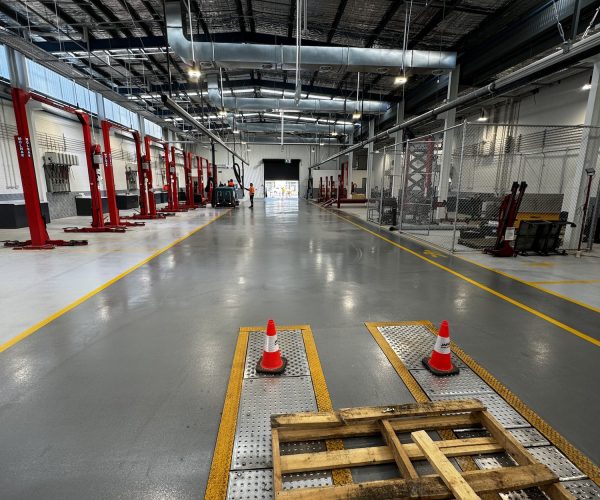
Safety markings, pedestrian walkways, and parking bays can all be integrated permanently into the floor during installation. Painted lines fade and peel under heavy traffic. Markings built into the coating don’t.
This matters for more than just appearance. Clear zoning helps separate foot traffic from machinery movement, which is a real safety consideration in a busy warehouse or retail back-of-house area.
Scheduling installation around your business
A commercial installation has to work around the fact that your business still needs to operate.
Most commercial epoxy projects are scheduled for off-hours or planned shutdown periods, to keep disruption to a minimum. The multi-coat system also needs specific curing time between layers, so the full process takes longer than a single-day job. Temperature and humidity can affect how quickly each layer cures, which is one of the things we account for when planning the schedule.
The floor also needs adequate time to reach full strength before it goes back into regular use. Rushing this stage is one of the most common causes of early coating failure, which is why a realistic timeline matters as much as the installation itself.
Is this the right fit for your space?
If your space deals with heavy foot traffic, machinery movement, or needs safety zoning built in, this is the kind of installation worth asking about specifically. Contact our Adelaide team to talk through what your space needs, and we’ll help you plan an installation with minimal disruption to your business.